Ask Tembo
Lion Conservation in Mozambique: Status, Threats and Action in 2026

Mozambique supports an estimated 1,208–1,489 lions across 11 conservation areas, but snaring, targeted poaching, prey depletion and human–lion conflict continue to threaten recovery. Gorongosa National Park is showing the strongest projected growth, while Niassa Special Reserve and Limpopo National Park face serious pressures. [1][2]
Quick answer: Lion conservation in Mozambique is at a critical but potentially recoverable point. A 2025 study identified approximately 1,208–1,489 lions in 11 conservation areas, with 37% of assessed populations increasing, 27% stable, 18% decreasing and 18% of unknown trend. [1] The country's most important conservation priorities are protecting habitat, reducing snaring and targeted poaching, maintaining wild prey, preventing retaliatory killing and ensuring that local communities benefit from conservation. [1][2]
Last reviewed July 2026. Conservation data changes — see the cited sources for the latest figures.
Why lion conservation matters in Mozambique
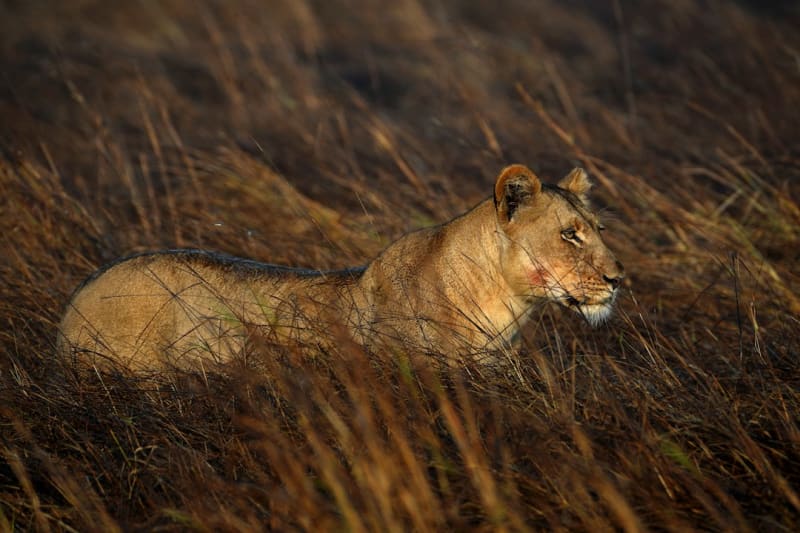
The African lion (Panthera leo) is a large carnivore of savanna, woodland, floodplain and other connected wild landscapes. Lions help regulate herbivore populations by taking old, sick or injured animals, while predation can reduce excessive grazing and browsing pressure. [5] Protecting lions therefore also protects prey species, habitats and the wider ecological processes that make Mozambique's national parks, reserves and wildlife-management areas valuable.
Mozambique remains important because it contains extensive landscapes capable of supporting free-ranging lions, including Niassa Special Reserve, Gorongosa National Park, Limpopo National Park, the Zambezi Delta, the Tchuma Tchato Community Programme and the Marromeu Ecosystem. The recent national assessment found extant lion populations in 11 conservation areas covering more than 125,970 square kilometres. [1]
National estimates have varied considerably between studies and years. An older government strategy cited an estimate of about 2,700 lions following a 2008–2009 assessment, while more recent research produced a conservative estimate of approximately 1,208–1,489 lions in the surveyed conservation estate. [1][8] These figures should not be treated as directly comparable national censuses: survey coverage, methods, detection rates and the areas included differ. The safest conclusion is that Mozambique retains a significant lion population, but its status is uneven and reliable monitoring remains essential.
Mozambique's conservation history also matters. Civil conflict severely affected wildlife and prey populations in parts of the country, while later investment in protected-area management enabled recovery in some landscapes. Gorongosa illustrates both the scale of the challenge and the possibility of restoration: its lion population rose from 10 individuals to 40 by 2015, 65 in 2017 and 150 in 2020, according to a 2026 review of conservation work in the park. [3]
Key threats to lions in Mozambique
Snaring and bushmeat poaching
Snares set for bushmeat can kill lions directly or cause severe injuries, including the loss of limbs. They are indiscriminate: a snare intended for an antelope or other prey can capture a lion as by-catch. [3][6] In Niassa Special Reserve, the Niassa Carnivore Project and conservation partners identify snares linked to bushmeat as one of the principal threats to the reserve's lions. [4]
Prey depletion compounds the problem. When commercial or subsistence bushmeat hunting reduces antelope, buffalo and other prey, lions have less food and may move farther in search of livestock or wild prey. The African Lion Database Project identifies prey-base depletion, often linked to poaching and unsustainable bushmeat trade, as a major driver of decline across the species' range. [6]
Targeted poaching for body parts
Targeted killing for lion bones, skins, claws and teeth is an emerging threat in Mozambique. The African Lion Database Project reports that this trade can cause significant local declines, while the Wildlife Conservation Network identifies a growing trade in lion skins, claws and teeth as a particular concern in Niassa. [4][6]
This threat differs from accidental snaring. Targeted poaching removes animals deliberately and can affect breeding adults, whose loss has disproportionate consequences for pride structure and population recovery. The Mozambique study found anthropogenic mortality to be a major factor shaping future population viability, especially where detection rates are low and law enforcement capacity is limited. [1][2]
Human–lion conflict and retaliatory killing
Lions and people share many of Mozambique's wild landscapes. Livestock losses can impose a serious financial and food-security burden on households, particularly where communities have limited access to veterinary services, secure livestock enclosures or alternative income. Retaliatory killing may follow livestock depredation, while poisoning can kill lions and other scavengers that feed on treated carcasses. [7][10]
Niassa Special Reserve contains communities that depend heavily on natural resources for agriculture, fishing, timber, bushmeat and other livelihoods. The Wildlife Conservation Network estimates that around 60,000 people live in Niassa, while a WCS Mozambique profile gives an estimate of approximately 40,000 residents; the difference reflects differing sources, dates or geographic definitions. Both sources agree that community livelihoods and conservation governance are central to the reserve's future. [4][7]
Habitat loss, weak connectivity and underfunding
Habitat conversion, agricultural expansion, settlement growth, illegal logging, artisanal mining and unmanaged natural-resource use can reduce the safe space available to lions and fragment populations. [6][7] Mozambique's national terrestrial conservation estate covers approximately 233,249 square kilometres, or 29% of the country, but designation alone does not guarantee effective protection. [1]
Insufficient funding affects patrols, ecological monitoring, community programmes and the ability to respond to conflict. The African Lion Database Project identifies weakly managed protected areas, conflict and lack of sufficient funding as threats that can undermine conservation outcomes. [6] Climate change may add pressure through changes in rainfall, water availability, fire regimes and prey distribution, but the research supplied for this article does not quantify its specific effect on Mozambique's lion populations. It should therefore be treated as a monitoring concern rather than assigned an unsupported national figure.
What is being done to conserve lions?
| Landscape or programme | Conservation significance | Documented challenge or result |
|---|---|---|
| Gorongosa National Park | Restoration combines protected-area management, prey recovery, monitoring and carnivore conservation. | The lion population reached 150 in 2020 after increasing from 10 during the earlier restoration period. A 2025–2026 analysis projects annual growth of 6.5% and ecological carrying capacity by 2040 under current conditions. [2][3] |
| Niassa Special Reserve | The Niassa Carnivore Project has monitored lions and other carnivores, with support from conservation partners including WCS and the Wildlife Conservation Network. | The reserve is an important lion stronghold, but high anthropogenic mortality, snares, body-part poaching and limited livelihood opportunities remain serious concerns. [1][4][7] |
| Limpopo National Park | Part of the Greater Limpopo landscape and a focus of the Greater Limpopo Carnivore Programme and Peace Parks Foundation. | Projected functional extirpation by 2030 is possible if the buffering effect of neighbouring areas is lost, according to the Mozambique population analysis. [2] |
| Marromeu Ecosystem and Zambezi Delta | Large wetland and floodplain landscapes offer potential for connected wildlife conservation. | Historical efforts to return lions to the wider Marromeu landscape included a translocation of 24 lions in 2018, according to contemporaneous reporting; long-term success depends on secure habitat, prey and effective management. [12] |
| National policy and research | ANAC's 2016 National Action Plan set objectives for lion management and conservation, while research teams now combine field data from multiple conservation areas. | Monitoring remains uneven: the 2025 study classified 18% of assessed population trends as unknown and reported low detection as a concern in Niassa. [1][9] |
Patrols, collars and evidence-led management
Effective lion conservation depends on more than counting animals. Rangers remove snares, investigate mortality, protect prey and respond to conflict. In Gorongosa, satellite collaring and anti-poaching patrols supported the removal of hundreds of snares and were associated with a lion population rebound described in the 2026 park review. [3]
Across Mozambique, conservation scientists and managers are increasingly using longitudinal population and mortality data to identify where intervention is most urgent. The national study drew on information from organisations including Mozambique Wildlife Alliance, the Niassa Carnivore Programme, Zambeze Delta Conservation, Gorongosa National Park, Panthera, the Endangered Wildlife Trust, ANAC, Peace Parks Foundation and the Greater Limpopo Carnivore Programme. [1]
Community conservation and responsible tourism
Local communities are not a peripheral consideration in lion conservation. They live alongside wildlife, bear the costs of livestock losses and often depend on natural resources. Dr Samantha Nicholson, Senior Carnivore Scientist and Manager of the African Lion Database, argues that conservation funding and actions should be designed around community needs and opportunities, with residents treated as enfranchised stakeholders who have clear incentives to coexist with lions. [2]
Community conservancies, wildlife-management areas and carefully structured partnerships can help connect conservation with employment, tourism revenue, improved services and conflict prevention. The model must be transparent: tourism income should reach communities and conservation operations, while visitor numbers and activities should remain compatible with ecological limits. SafariFind's guide to community conservancies in Mozambique provides wider context on this relationship.
A question about Mozambique? Ask Tembo
Safari tourism can support conservation through park fees, lodge concessions, guiding jobs, local procurement, research partnerships and donations. These benefits are not automatic, and a safari should not be described as conservation-positive simply because it takes place near a protected area. Ask operators how fees are allocated, whether they support local employment and community programmes, and how they minimise disturbance. Travellers can book conservation-supporting safaris on SafariFind, while comparing the operator's claims with published park or programme information.
For trip planning, a Mozambique safari and beach holiday itinerary may combine wildlife areas with coastal destinations, but visitors should remember that lion sightings are never guaranteed. A comparison such as zanzibar vs mozambique is primarily a holiday-planning question; Mozambique's conservation value lies in its protected landscapes and community partnerships, not in promises of guaranteed predator encounters.
Results and setbacks: a mixed conservation picture
Mozambique has clear evidence of progress in selected landscapes. Gorongosa's lion recovery demonstrates what long-term restoration, anti-poaching work, monitoring and habitat management can achieve. [3] The national assessment also found that more than one-third of reported populations were increasing. [1]
Those gains are not yet secure. The same assessment found that 18% of populations were decreasing and 18% had unknown trends. [1] Projections to 2040 show a marked contrast between Gorongosa, where low mortality supports strong growth, and Niassa, where the population is projected to stagnate at roughly half its ecological carrying capacity under the modelled conditions. Limpopo faces an especially serious risk if landscape-level connectivity and neighbouring protection weaken. [2]
The central lesson is that Mozambique does not have one national lion story. It has recovering, stable, declining and poorly monitored populations. Conservation success must therefore be measured park by park and landscape by landscape, using consistent surveys, mortality records and transparent reporting.
How travellers can help responsibly
- Choose evidence-based operators: ask which protected area or community programme receives financial support and request specific, verifiable information.
- Respect wildlife space: follow guide instructions, remain in vehicles where required and never pressure guides to approach, chase or crowd lions.
- Support local economies: use locally owned services where possible, choose lodges with community-benefit policies and respect local rules and cultures.
- Do not buy wildlife products: avoid souvenirs made from lion skins, claws, teeth, bones or other protected wildlife parts. Targeted trade in these items is a documented threat. [4][6]
- Support credible conservation organisations: consider donations to established programmes such as the Niassa Carnivore Project, WCS Mozambique, Gorongosa National Park initiatives or other organisations that publish their objectives and results. [1][3][4][7]
- Plan health and entry requirements separately: conservation information does not replace official travel advice. Singaporean visitors can consult SafariFind's guide to Mozambique vaccinations and health rules; travellers should verify current requirements with the relevant authorities.
Responsible visitors also help by setting realistic expectations. A lion conservation safari is not a guarantee of sightings; it is an opportunity to support landscapes where wildlife, rangers and communities are working under difficult conditions. The most valuable contribution is informed travel that rewards effective, accountable conservation over spectacle.
Frequently Asked Questions
How many lions are left in Mozambique in 2026?
The most recent study supplied here estimated approximately 1,208–1,489 lions across 11 Mozambican conservation areas. The estimate is conservative and should not be compared directly with older national figures because survey coverage and methods differ. [1]
Is the lion population in Mozambique increasing or decreasing?
Both trends occur. Conservation managers reported 37% of assessed populations as increasing, 27% stable, 18% decreasing and 18% unknown. Gorongosa is projected to grow strongly, while Niassa and Limpopo face major pressures. [1][2]
Which is Mozambique's most important lion stronghold?
Niassa Special Reserve is described as one of Mozambique's important remaining lion strongholds, with around 800 lions cited by the Wildlife Conservation Network. However, recent research warns that high mortality and low detection rates may suppress its population. [2][4]
What is the biggest threat to lions in Mozambique?
There is no single threat nationwide. Snaring for bushmeat, targeted poaching for body parts, prey depletion, habitat pressure and retaliatory killing linked to livestock losses all contribute to lion mortality and decline. [1][4][6][7]
What happened to lions in Gorongosa National Park?
Gorongosa's lion population increased from 10 individuals to 40 by 2015, 65 in 2017 and 150 in 2020, according to a 2026 review. The park is also projected to have the strongest annual growth rate among the Mozambican populations modelled in the recent study. [2][3]
Does tourism help lion conservation in Mozambique?
Tourism can help through park fees, jobs, local procurement, lodge concessions and support for conservation programmes, but benefits are not automatic. Travellers should ask operators how money reaches protected-area management and local communities.
How can visitors avoid harming lions during a Mozambique safari?
Follow guide instructions, keep a respectful distance, never request a closer approach or pursuit, avoid buying lion body parts and choose operators that can explain their conservation and community partnerships. Targeted trade in skins, claws and teeth is a documented threat. [4][6]
Are lions critically endangered in Mozambique?
The Wildlife Conservation Network page supplied for Niassa lists the African lion as Critically Endangered. At the national level, Mozambique's lion populations have different trends and levels of certainty, so conservation status should be assessed alongside local population data. [4][1]
What role do communities play in lion conservation?
Communities are essential because they share landscapes with lions and bear costs such as livestock losses. Conservation programmes need to provide clear incentives, meaningful participation and livelihood opportunities while reducing conflict and unsustainable resource use. [2][4][7]
What is the outlook for Mozambique's lions by 2040?
The outlook varies sharply by landscape. Gorongosa is projected to grow at 6.5% annually and reach ecological carrying capacity by 2040, while Niassa may remain around half its carrying capacity and Limpopo could face functional extirpation as early as 2030 if key protection and buffering are lost. [2]
Trips that match this guide